Get in the Swing by Mike Yardley
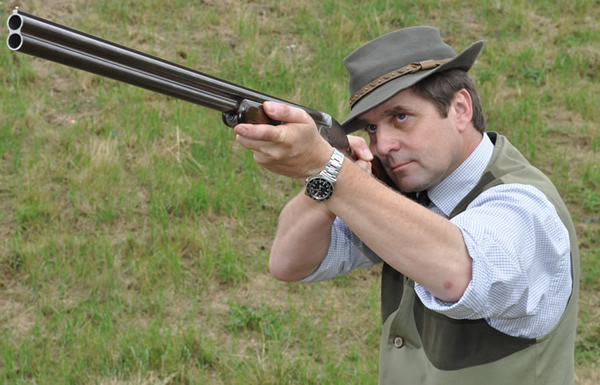
Experiment and observation suggests, in fact, about 10 different ways a clay target can be shot excluding hybrid techniques. As for the hybrids, without getting too complicated, and just for interest, you could add such things to the list as 'swinging-through and sustaining' (i.e. coming from behind the clay only to maintain a lead once past it – a surprisingly common practice), or, 'pointing and sustaining' (establishing an initial target-barrel relationship before maintaining a lead). I am not advocating either. Indeed, I would advise against both. But, you get the point, there are lots of unconventional ways to shoot a target if you stop to consider it for a while (or look at any group of shooters doing their own thing).
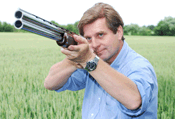
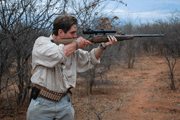
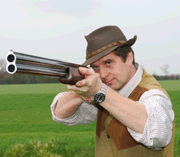
Most techniques of forward allowance, require some sort of swing (there are exceptions – ambushing with a stationary gun, and 'spot shooting' amongst them). As a shooting instructor, I watch a lot of people shooting, and note that many do not swing their guns as well as they might, some barely swing them at all! Instead, and it is one of the most common errors of basic technique, they often generate movement of the gun with their arms rather than using core body rotation (which should involve movement all through the body but notably of the hips and upper torso).
Some develop very strange idiosyncrasies because they have never learnt to use their body to power the swing (or understood the need to). The body has not become 'the engine'. O.K. let'e be practical. Just to demonstrate what I am talking about, I would ask you to stand up now and extend both arms out (palms down). Don't worry about stance, just stand square, feet shoulder width apart. Keeping the arms extended, and the back relaxed but fairly straight, swing to the right and swing to the left as if in a P.E. class. Keep the shoulders level. Feel the movement in your hips and torso, make the effort to stay level. This is one component in a controlled, efficient, swing.
Although the arms should not generate the primary power for the swing, they nevertheless have a vital role to play. In shooting a crossing target, the front arm/hand (for most the weaker), has to perform several tasks. Most obviously it lifts the gun and controls the muzzles. Some may let the rear hand dominate the mount. This is a big mistake which will lead to wind-milling of the gun (usually about the axis of the front hand). So, just as most do not use enough core body movement, and some may over-use the rear hand, most do to not use the front hand and arm sufficiently.
You must understand the movement/control required. As the body rotates during the swing on a crossing target [which will be made much easier if you position your feet to where you want to break the clay – this will also prevent you coming off line and unintentionally transferring weight from the leading foot to the other] the front arm will lift the gun as noted. To be precise, though, it exerts a diagonally upwards force across and to the front of the chest area as the rotational torso movement simultaneously occurs. The two things must be co-ordinated.
The front hand placed, effectively on the forend (mid-way on an over under usually), subtly but vitally controls the muzzles as well (and a good tip for refined shooting is to think about using the last few inches of the barrels rather than just the barrels as a whole). Now consider again this controlling, lifting, role of the front arm as it is combined in time with the core body rotation – get a picture of it in your mind's eye – try it with a proven empty gun, and, without the gun. As discussed the two movements happen simultaneously. Once you understand what is required, it will be much easier to do, but it is not an especially natural movement – it is sport specific – something to be learnt.
If you are shooting sporting or skeet, gun-down, moreover, I do not advise that you call for the target, mount the gun and then move. The core body movement begins as you refine focus on the target. We could argue about what the front hand does while the gun is unmounted – in my view, it's role is to bring the gun to the target in preparation for mounting on or near the target. Many poor shots begin their movements late. The accomplished performer, however, is well prepared with regard to hold and visual pick-up point. He looks as if he has all the time in the world, the target does not take him (or her) by surprise. There is usually no need to rush. He shoots with economy of movement, but fluidity.
Let us consider the sequence on a crossing bird, let's say low 3 on a skeet range. You prepare yourself well considering break point, gun hold and visual pickup. You call for the target. You see it evolve from a blur to a solid object and start refining fine focus. As you do, the rotation begins immediately but smoothly (it feels as if you are rotating the upper body, but the movement is evident all the way through the body from the lower legs up). The front hand simultaneously helps to bring the muzzles to the target in a controlled manner. You mount on the clay smoothly and pull-away completing the shot (even with other techniques the rotational movement and unhurried mount are apparent).
O.K. We have considered the crossing shot, what about driven shots? There may be an en element of body in rotation in these sometimes when they go to the side, but let us consider them more simply – those coming straight towards you. Instead of body rotation, there is often a need for body bending/arching with the driven shot (which achieves the same powering function as body rotation with the crossing shot). A high driven shot may be taken by means of weight transfer from front to rear foot too, or, indeed, with your C of G remaining central, but most good performers (unless they are having back problems) prefer to push the hip forward and arch the body creating an elegant bow form of the body (note Mr Stanbury). With the overhead shot, they may begin with the body pre-arched and muzzles up and then come down on to the bird. This is one of the few situations where I think a lot of good shooters do make a weight transfer. They start in this unusual circumstance with the weight on the rear foot, and transfer it to the front as the gun comes down to the target and as the body comes into a more relaxed position. It is once again notable that the front hand has an important role to play and that the heel of the rear foot may act as a driver for the shot helping to push the C of G slightly forward.